
How to Quit Smoking: A Step-by-Step Plan for Adults
By Todd Lahman ·
To quit smoking, choose a quit date no more than a week or two away, learn your triggers, and line up support before the day comes (Smokefree.gov). Stopping completely on that date is the route health services recommend first, but if you're not ready to stop straight away, NHS inform describes cutting down to quit, with a quit date no more than 6 weeks away (NHS inform). Here's how to choose your route, get through cravings and withdrawal, what changes after your last cigarette, and where to get free help.
Why is smoking so hard to quit?
Nicotine is the reason. "Nicotine is a chemical in cigarettes that makes you addicted to smoking," Smokefree.gov explains: over time your body gets used to it, and when it doesn't get nicotine, "you may feel uncomfortable and crave cigarettes" (Smokefree.gov).
Habit is the other half. "When you smoke, certain activities, feelings, and people become linked to your smoking," and those links can trigger the urge (Smokefree.gov).
It's hard, but it's common to get there: "More than half of U.S. adults who smoked have quit," according to the CDC (CDC).
Step 1: Get ready to quit
- Know your reasons. "Before you actually quit, it's important to know why you're doing it" (Smokefree.gov). Health, money and family are common ones. Write yours down where you'll see them.
- Find your triggers. "Triggers are specific persons, places, or activities that make you feel like smoking" (Smokefree.gov). For a few days, notice when you light up: the first coffee, the drive, breaks, stress, a drink with friends.
- Pick your date. "Choose a date that is no more than a week or two away" (Smokefree.gov). That leaves time to prepare without losing your motivation.
- Clear out cigarettes. The CDC suggests getting rid of all the cigarettes in your home, car and workplace before you quit, along with "things that you use while smoking like lighters, matches, and ashtrays" (CDC).
- Tell people. "Quitting smoking is easier when the people in your life support you" (Smokefree.gov). Ask them to check in, and ask the people who smoke around you not to offer you one.
Step 2: Choose your route - stop on your quit date, or cut down to it
There are two routes, and both end the same way: no cigarettes at all.
- Stop completely on your quit date. NHS inform says "it's always best to quit smoking completely on a set date" (NHS inform). The NHS is also honest that going cold turkey "can be really tough," and that "willpower alone is often not enough," so line up support and ask about quit products first (NHS).
- Cut down to quit. "Not everyone is ready to stop straight away," NHS inform notes. If that's you, set a quit date within 6 weeks ("even better if earlier") and smoke fewer cigarettes every day, week and fortnight until that date (NHS inform).
If your quit date comes and goes, set a new one. Quitting often takes more than one try. In 2022, 53.3% of U.S. adults who smoked tried to quit in the past year, and 8.8% of adults who smoked quit successfully in that time (CDC). A study that followed smokers in Ontario estimated the average number of attempts before quitting for good at between about 6 and 30, depending on how the attempts are counted, and concluded that "for many smokers it may take 30 or more quit attempts before being successful" (BMJ Open). If you go back to smoking, NHS inform's advice is to "set a new quit date, maybe in a week or a month," because "the more times you try, the better your chances of success" (NHS inform).
Know the trade-offs of cutting down before you pick it. NHS inform says there's "very little, if any, health benefit from cutting down the number of cigarettes you smoke": the benefit comes from stopping completely. It also warns that cutting down "can take more commitment and discipline than stopping abruptly" (NHS inform). So think of cutting down as the road to your quit date, not a place to stay.
What the research says about cutting down. A Cochrane review of 51 trials found that people asked to stop all at once "were not more likely to quit than people who were asked to cut down their smoking before quitting," which suggests that cutting down first "may be a useful way to help people to stop smoking." People who cut down may be more likely to quit when they use fast-acting nicotine replacement (gum or lozenges) or get face-to-face support than when they cut down on their own (Cochrane).
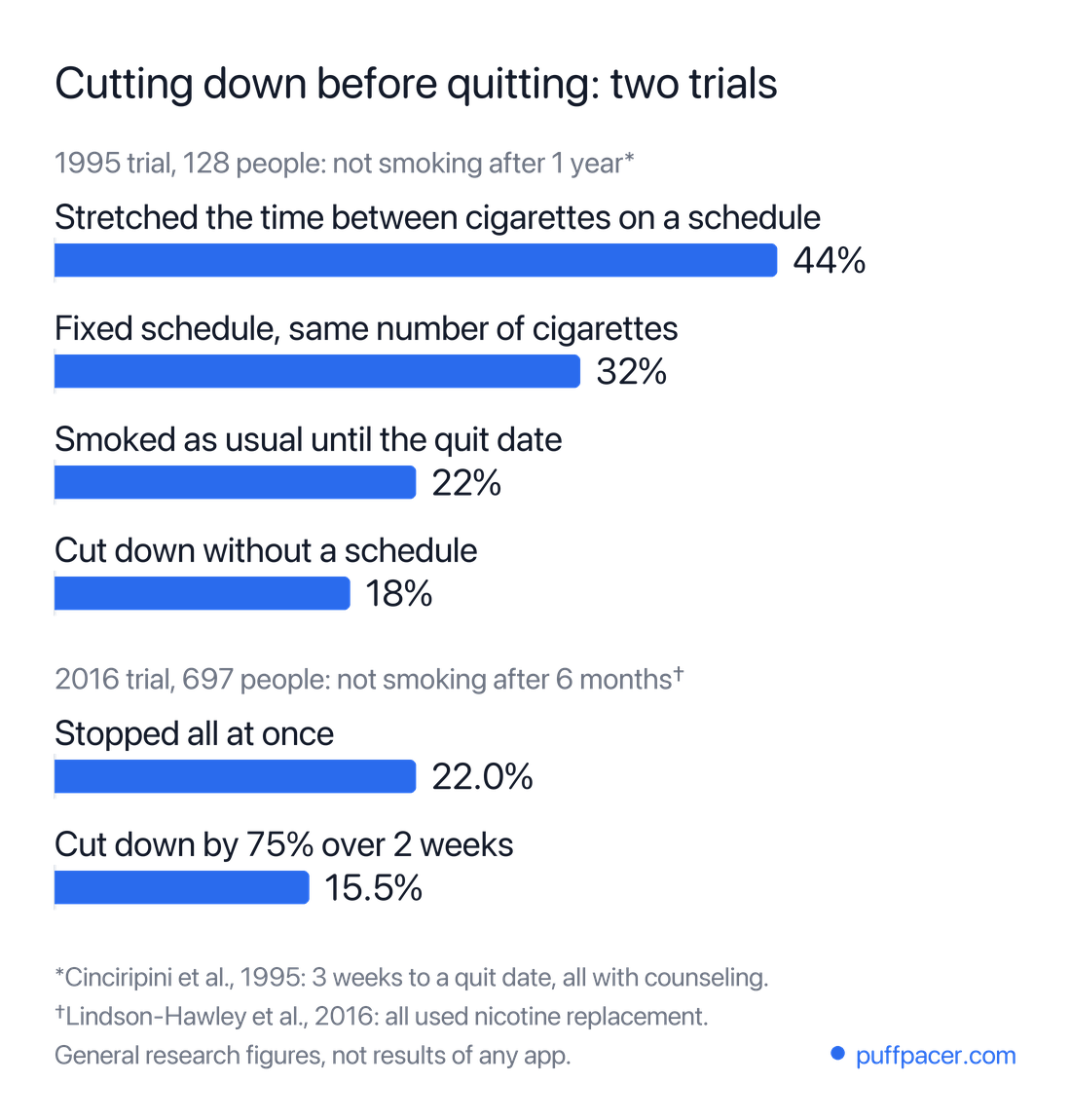
How you cut down may matter too. In a small 1995 trial of 128 people, everyone had relapse prevention counseling and a quit date 3 weeks away. Those who stretched the time between cigarettes on a set schedule were the most likely to still be smokefree a year later: 44%, compared with 18% for people who cut down without a schedule and 22% for people who smoked as usual until their quit date (Journal of Consulting and Clinical Psychology). Everyone in that trial had the same 3 weeks, so the schedule, not the length, set that group apart.
That's a promising sign, not proof. It was one small study, and the Cochrane review found "not enough information" to say which ways of cutting down work best. A larger 2016 trial found that stopping abruptly worked better than cutting down by three-quarters over 2 weeks (Annals of Internal Medicine).
Step 3: If you cut down, plan the steps
NHS inform's advice for cutting down to quit (NHS inform):
- Set goals. Plan how many fewer cigarettes you'll smoke each day, each week or each fortnight.
- Keep going down as your quit date gets closer.
- Change your habits. For example, "go for a walk after dinner instead of having a cigarette."
- Watch how you smoke. Don't make up for fewer cigarettes "by inhaling deeper and taking more puffs to get the same nicotine effect."
The hard part is spacing cigarettes out by feel, all day long. Puff Pacer's pacing countdown keeps the clock for you: log a cigarette with one tap from the app, your Lock Screen, Apple Watch or Android's Quick Settings, and the countdown shows when your next one fits your plan. The gaps stretch a little every day, and you choose the plan length, so you can set it to end on your quit date.
Step 4: Have a plan for cravings
A craving doesn't last. "For most people, the urge will begin to dissolve after a few minutes," the CDC says, and while more urges will come, "they will weaken with time" (CDC). The job is to get through those few minutes. Smokefree.gov suggests (Smokefree.gov):
- Call or text someone. "You don't have to do this alone."
- Review your reasons, and calculate what you're saving.
- Keep your mouth busy, or do something else.
- Go for a walk or jog.
- Take slow, deep breaths.
- Go to a smokefree zone, such as a public place where you can't smoke.
The CDC adds: "Find some substitutes for cigarettes for your mouth and hands" (CDC).
Puff Pacer's Craving SOS puts these in one tap: a ride-it-out timer, guided breathing, and the replacements you choose, like a walk, water or gum.
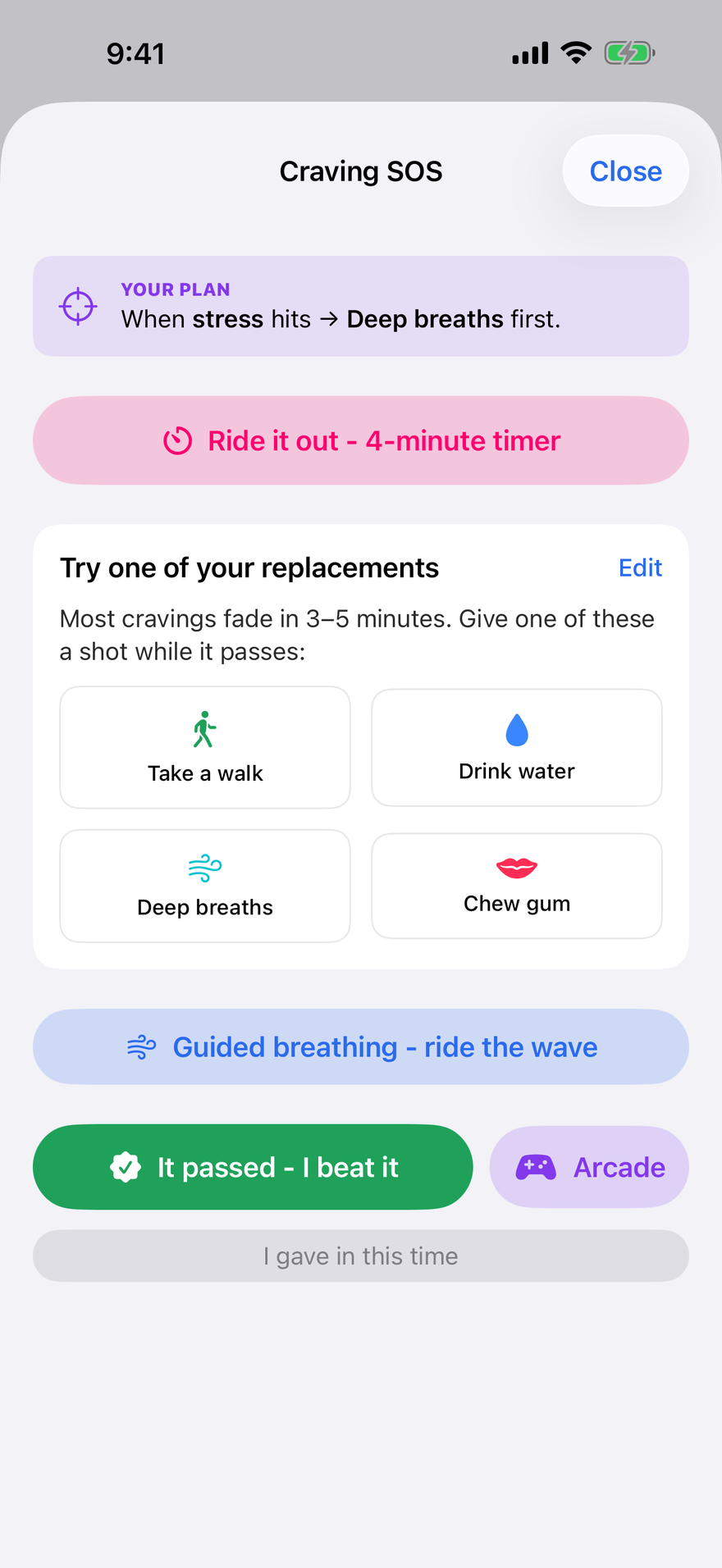
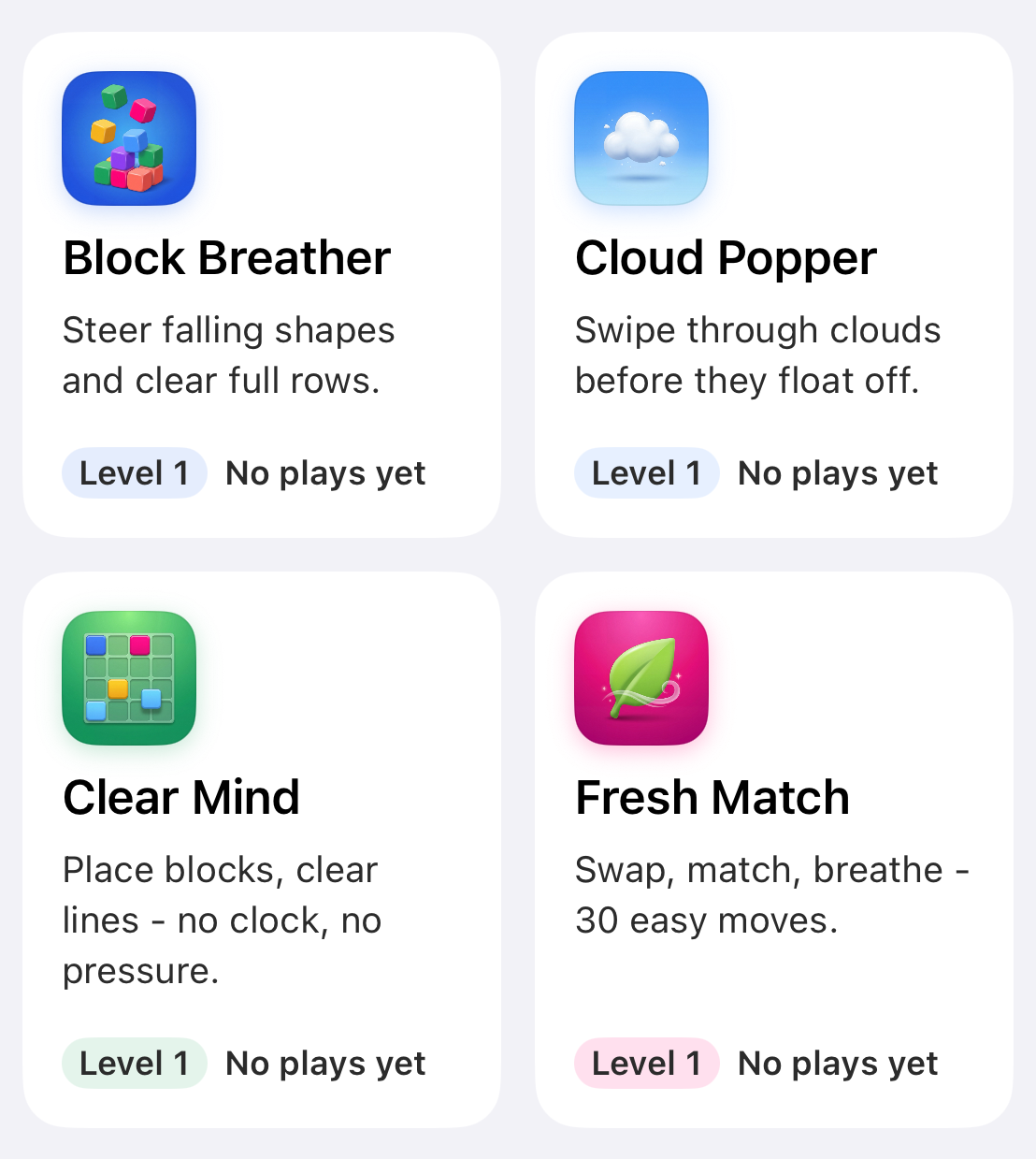
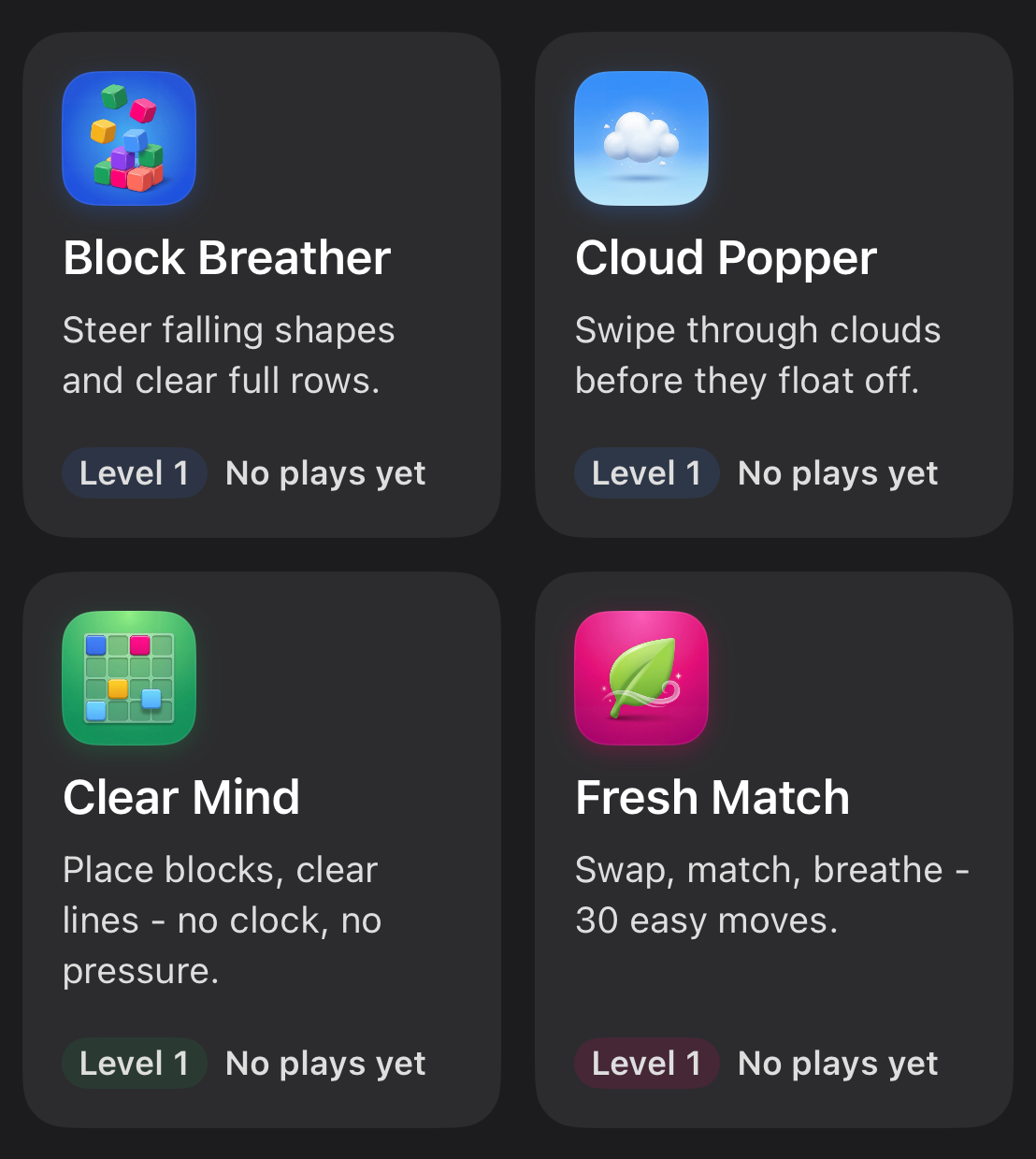
For the minutes when you need to keep your hands busy, the Arcade has four original mini-games built to last as long as a craving does.
Step 5: Know what withdrawal feels like
Withdrawal is uncomfortable, but the worst of it is short. Common symptoms include cravings for cigarettes, feeling irritable or restless, trouble sleeping or concentrating, feeling sad or anxious, and feeling hungrier, and "the worst withdrawal symptoms only last a few days to a couple of weeks" (Smokefree.gov).
Smokefree.gov's suggestions for getting through it (Smokefree.gov):
- Keep a sleep routine: go to bed and wake up at the same time each day.
- Move: walking, yard work or chores can burn off restless energy.
- Keep healthy snacks handy: crunchy foods like carrots or nuts keep your hands and mouth busy.
If you cut down first, expect harder days right after each step down, and plan something for them.
Step 6: If you slip, restart right away
One cigarette doesn't undo your quit. "Remind yourself that a slip is just a temporary setback. You have not failed and you're not back to square one," Smokefree.gov says. Think about why it happened, and if you've started smoking again, "restart quitting right away," today or tomorrow at the latest (Smokefree.gov).
Log the slip honestly instead of hiding it. It shows you which moment needs a better plan, and the days you've already done still count.
What happens after your last cigarette?
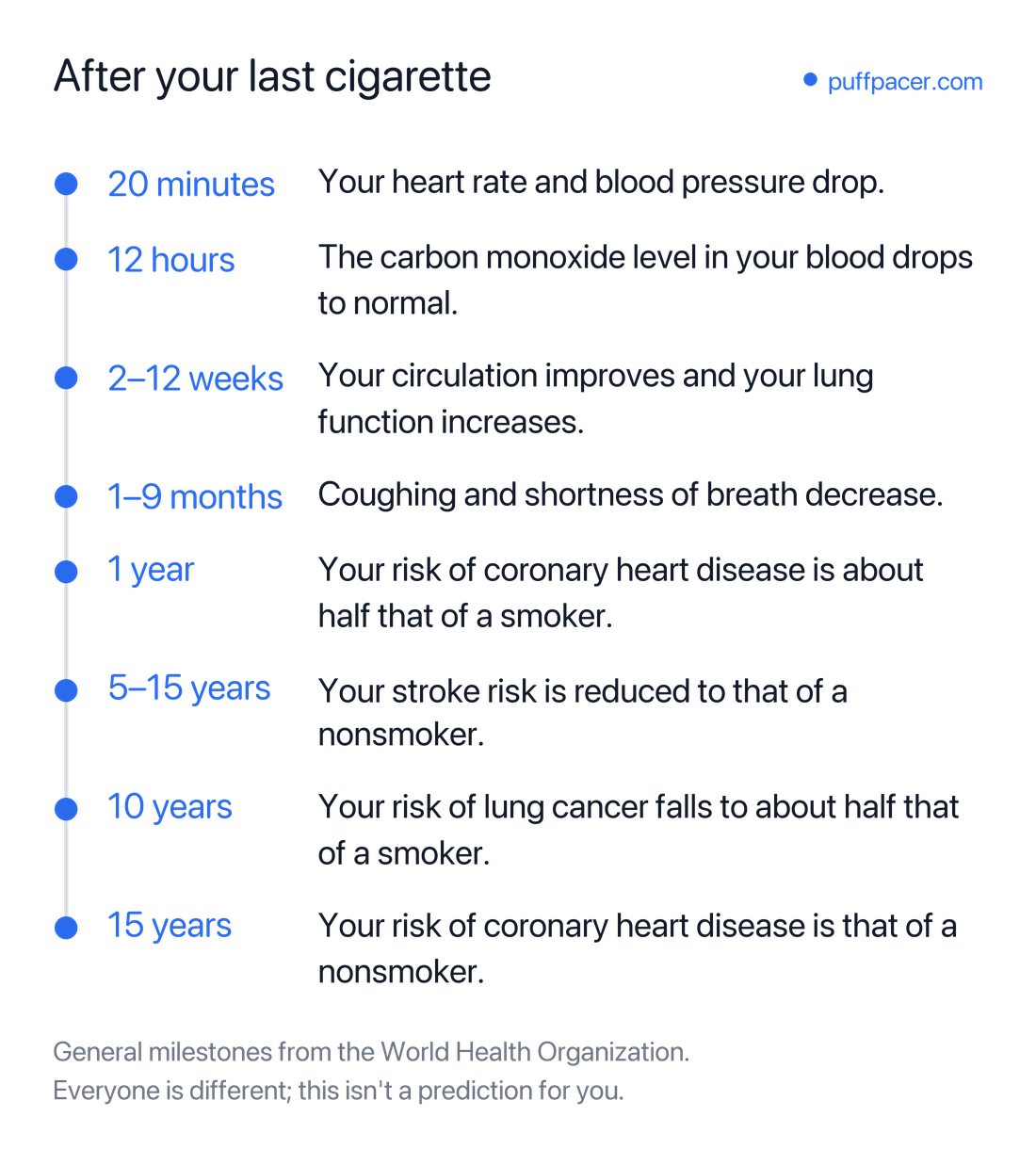
Changes start sooner than most people expect. The World Health Organization lists these milestones after quitting (WHO):
- 20 minutes: your heart rate and blood pressure drop.
- 12 hours: the carbon monoxide level in your blood drops to normal.
- 2–12 weeks: your circulation improves and your lung function increases.
- 1–9 months: coughing and shortness of breath decrease.
- 1 year: your risk of coronary heart disease is about half that of a smoker's.
- 5–15 years: your stroke risk is reduced to that of a nonsmoker.
- 10 years: your risk of lung cancer falls to about half that of a smoker.
- 15 years: your risk of coronary heart disease is that of a nonsmoker's.
It's never too late to start. "Quitting smoking is beneficial to health at any age," according to the CDC, and quitting "can add as much as 10 years to life expectancy" (CDC).
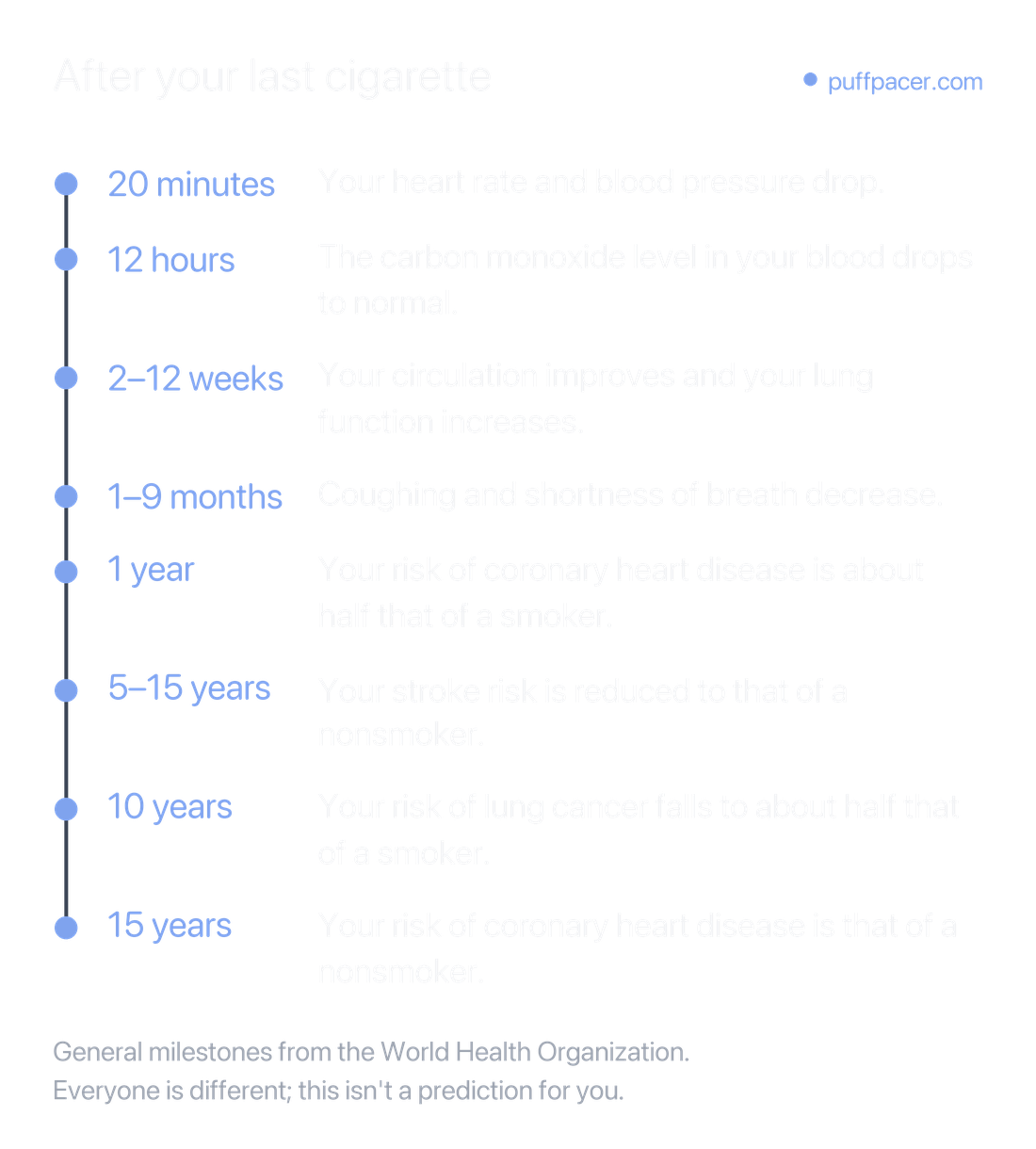
When you set a quit date in Puff Pacer, it shows a timeline of general health milestones like these, from public health sources. They're general milestones, not a measurement of your body.
Does nicotine replacement or counseling make a difference?
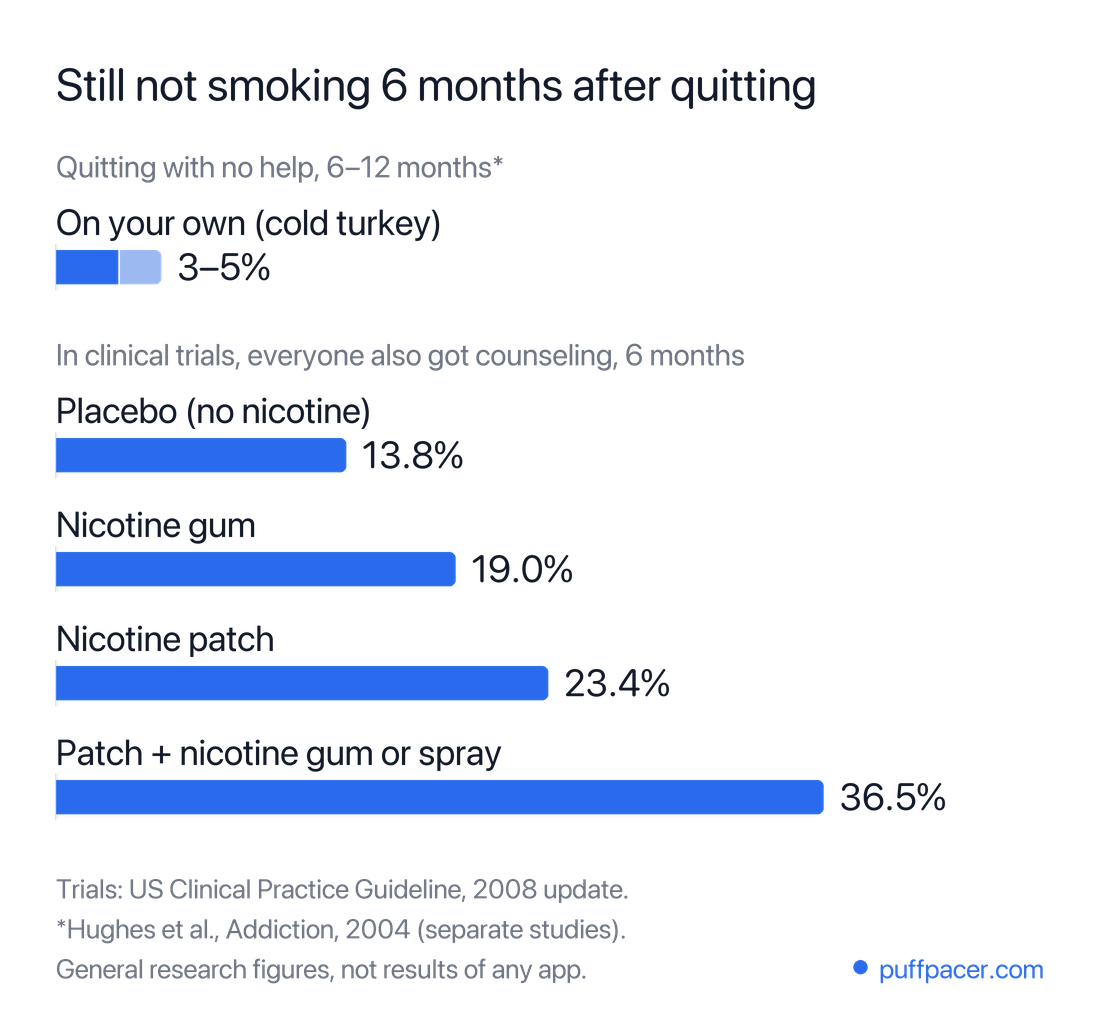
In the research, more people stay quit with help than on their own. A review of studies of people quitting with no help at all found that 3–5% are still not smoking 6 to 12 months later (Addiction). In the clinical trials summarized in the US Clinical Practice Guideline, where everyone also got counseling, an estimated 13.8% of people on a placebo weren't smoking 6 months after their quit date, compared with 19.0% on nicotine gum, 23.4% on the nicotine patch (AHRQ) and 36.5% on the patch plus nicotine gum or spray (AHRQ).
A Cochrane review of 136 trials of nicotine replacement products found that "the chances of stopping smoking were increased by 50% to 60%," and that they work "with or without additional counselling" (Cochrane).
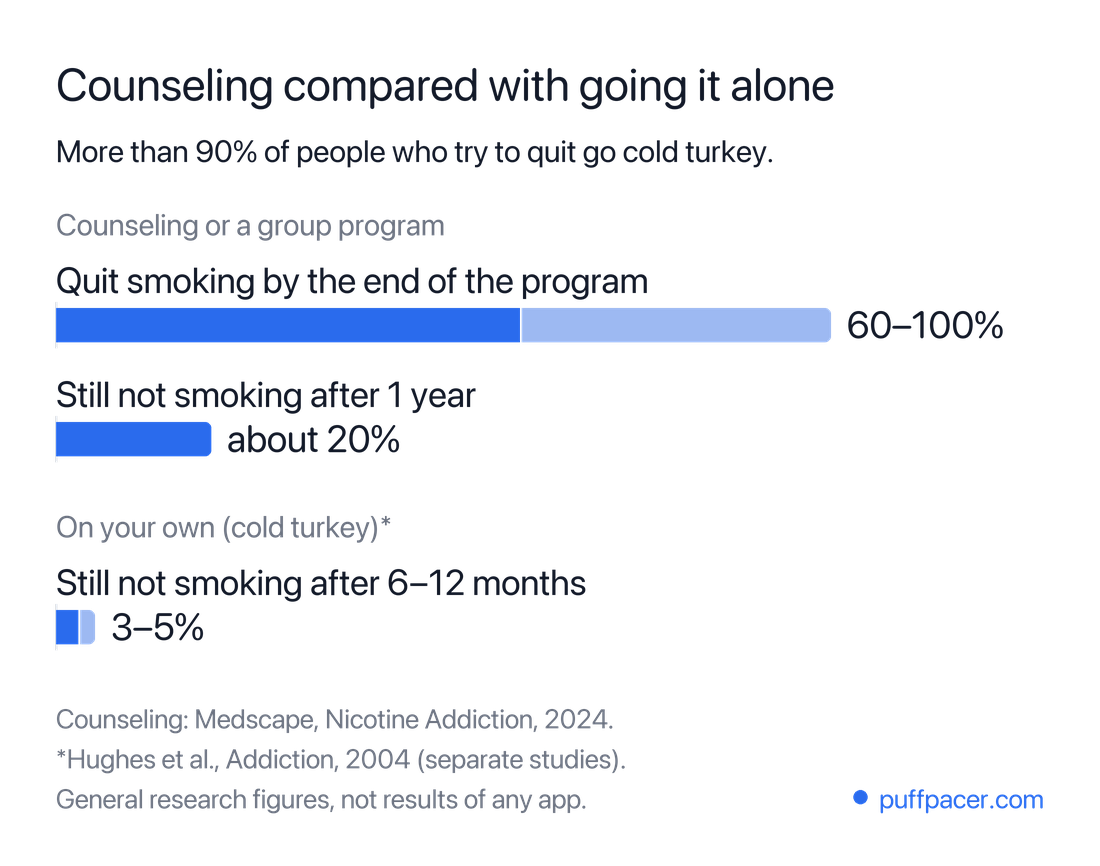
Most people still try alone. Medscape's clinical reference notes that "more than 90% of patients who attempt to quit smoking stop cold turkey," and that professional group programs or counseling help 60–100% of people quit smoking by the end of the program, with about 20% still not smoking after one year (Medscape).
These are averages across groups of people in studies, not a prediction for you. Nicotine replacement products aren't right for everyone, so ask a pharmacist or doctor which ones fit you, especially if you're pregnant, have a health condition or take medication.
Where to get free help
You don't have to quit alone. In the US, you can "get free confidential coaching through a quitline (1-800-QUIT-NOW)," and counseling "can help you make a plan to quit smoking," the CDC says (CDC). Smokefree.gov also offers a text message program and live chat with a counselor, because "quitting cold turkey is not your only choice" (Smokefree.gov).
In England, "expert advisers at your local Stop Smoking Service offer free advice and help" (NHS). Elsewhere, ask a doctor or pharmacist about your local quit service.
Nicotine replacement products (gum, lozenges, patches) and other quit medicines are a recognized way to manage cravings and withdrawal; the CDC notes that medications "can help you manage nicotine withdrawal symptoms and cravings" (CDC). A pharmacist or doctor can tell you which fit you.
Quitting other nicotine too? See how to quit vaping and how to quit Zyn and nicotine pouches.
Sources
- Smokefree.gov (National Cancer Institute), Prepare to Quit.
- Smokefree.gov (National Cancer Institute), Why Is Quitting Smoking Hard?.
- Smokefree.gov (National Cancer Institute), How to Manage Cravings.
- Smokefree.gov (National Cancer Institute), Managing Nicotine Withdrawal.
- Smokefree.gov (National Cancer Institute), Get Back on Track After a Setback.
- NHS inform (Public Health Scotland), Cutting down before you quit smoking, 2026.
- NHS inform (Public Health Scotland), Stopping smoking after a relapse, 2026.
- Chaiton M, et al., BMJ Open, Estimating the number of quit attempts it takes to quit smoking successfully in a longitudinal cohort of smokers, 2016.
- NHS, Should I quit smoking cold turkey?.
- Centers for Disease Control and Prevention, How to Quit Smoking, 2024.
- Centers for Disease Control and Prevention, Tips For Quitting, 2024.
- Centers for Disease Control and Prevention, Benefits of Quitting Smoking, 2024.
- Centers for Disease Control and Prevention, Smoking Cessation: Fast Facts, 2024.
- Agency for Healthcare Research and Quality, Treating Tobacco Use and Dependence: 2008 Update, medications compared to placebo at 6 months (monotherapies) and (combination therapies), 2008.
- Hartmann-Boyce J, et al., Cochrane Database of Systematic Reviews, Nicotine replacement therapy versus control for smoking cessation, 2018.
- Medscape (R. Gregory Lande), Nicotine Addiction (Treatment: Approach Considerations), updated 2024.
- Lindson N, et al., Cochrane Database of Systematic Reviews, Smoking reduction interventions for smoking cessation, 2019.
- Cinciripini PM, et al., Journal of Consulting and Clinical Psychology, The effects of smoking schedules on cessation outcome, 1995.
- Lindson-Hawley N, et al., Annals of Internal Medicine, Gradual versus abrupt smoking cessation: a randomized, controlled noninferiority trial, 2016.
- Hughes JR, et al., Addiction, Shape of the relapse curve and long-term abstinence among untreated smokers, 2004.
- World Health Organization, Tobacco: health benefits of smoking cessation.
Frequently asked questions
Is it better to quit smoking cold turkey or cut down first?
Both can work. A Cochrane review of 51 trials found that people asked to stop all at once were not more likely to quit than people asked to cut down first. NHS inform still calls stopping on a set date best and, if you cut down, advises a quit date within 6 weeks. Talk to a healthcare professional about which route fits you.
How long does nicotine withdrawal last after quitting smoking?
According to Smokefree.gov, the worst withdrawal symptoms only last a few days to a couple of weeks. Common symptoms include cravings for cigarettes, irritability, restlessness, trouble sleeping or concentrating, feeling sad or anxious, and feeling hungrier. A regular sleep schedule, physical activity and healthy snacks can help you get through them.
How long does a cigarette craving last?
Usually only a few minutes. The CDC says that for most people, the urge will begin to dissolve after a few minutes, and that urges weaken with time. Smokefree.gov suggests riding one out by texting a friend, keeping your mouth busy, going for a walk, taking slow deep breaths or reviewing your reasons for quitting.
What happens to your body when you quit smoking?
According to the World Health Organization, within 20 minutes your heart rate and blood pressure drop, and after 12 hours the carbon monoxide level in your blood drops to normal. Within 2 to 12 weeks circulation and lung function improve, and after 1 year the risk of coronary heart disease is about half that of a smoker's.
Where can I get free help to quit smoking?
In the US, the CDC points to free, confidential coaching through the quitline at 1-800-QUIT-NOW, and Smokefree.gov offers a text program and live chat with a counselor. In England, local NHS Stop Smoking Services offer free advice and help. Elsewhere, ask a doctor or pharmacist about your local quit service and quit medicines.
Keep reading
Ready to quit at your pace?
Download Puff Pacer free and get a personalized taper plan for vaping, smoking, nicotine pouches, or chewing tobacco.


Disclaimers
Not medical advice. This article is for general information and education only. It is not medical advice and is not a substitute for advice, diagnosis or treatment from a doctor, pharmacist or other qualified healthcare professional. Talk to one before changing how you use nicotine or starting nicotine replacement products, especially if you are pregnant or breastfeeding, have a health condition or take medication. Reading this article does not create a doctor-patient relationship. In a medical emergency, call your local emergency number.
About the app. Puff Pacer is for building healthier habits and general wellbeing. It is not a medical device and is not intended to diagnose, treat or prevent any disease, including nicotine dependence. It is not medical advice: talk to a healthcare professional. Puff Pacer is for adults 18 and older.
Accuracy. We link our sources so you can check them. Health guidance changes over time, and this article reflects its sources as of its last update. It may not cover every situation.
Disclosure. The author, Todd Lahman, is the developer of Puff Pacer, the app mentioned in this article, and this site is published by Todd Lahman LLC. No one paid for this article, and it contains no affiliate links.
Trademarks and links. Zyn and other product names mentioned are trademarks of their respective owners, used only to describe their products. Puff Pacer is not affiliated with or endorsed by them. Links to other websites are for reference, and we don't control their content.
Use of this site is subject to our Terms of Use and Privacy Policy.