
How Long Does It Take to Break a Nicotine Habit?
By Todd Lahman ·
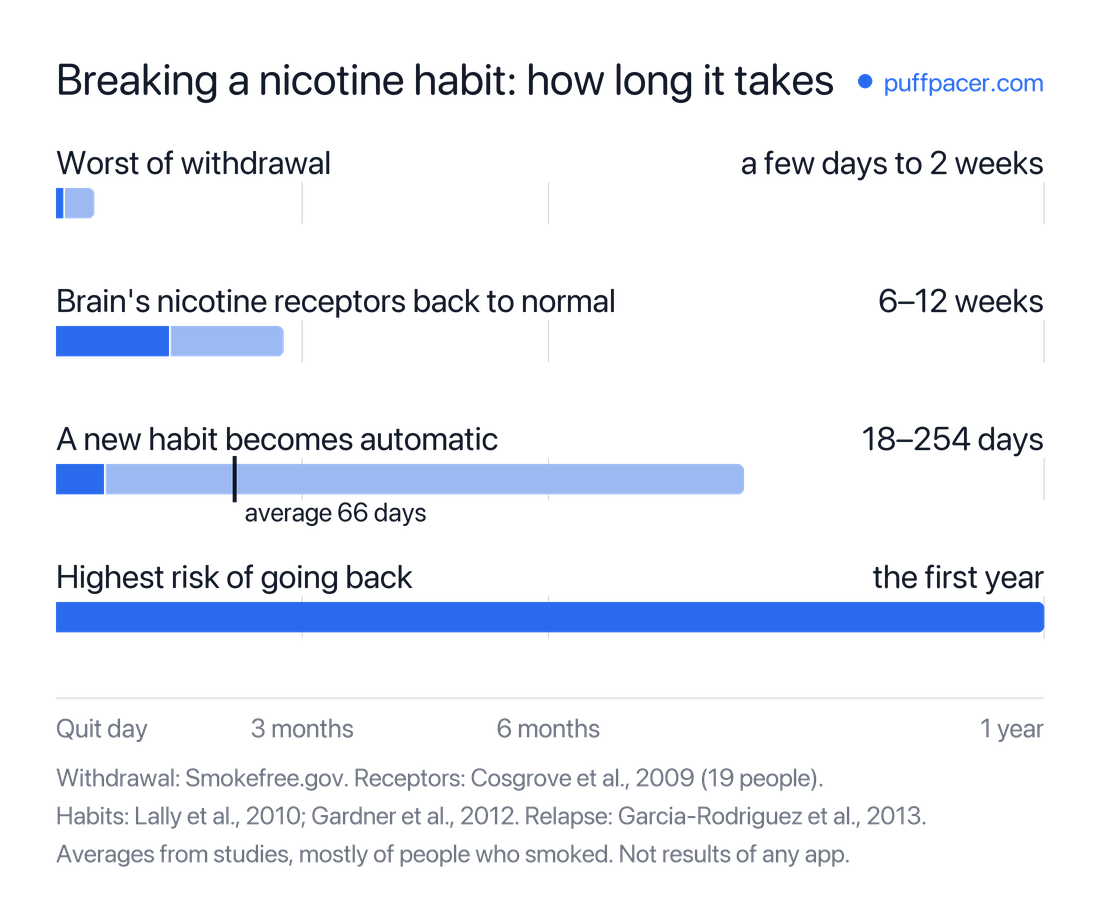
Breaking a nicotine habit takes longer than getting through withdrawal does. The worst withdrawal symptoms usually last a few days to a couple of weeks (Smokefree.gov), and in a brain-imaging study of people who quit smoking, nicotine receptors were back to nonsmoker levels by 6 to 12 weeks (Archives of General Psychiatry). The habit itself can take months: in one study, a new daily habit took an average of 66 days to become automatic (British Journal of General Practice), and anywhere from 18 to 254 days (European Journal of Social Psychology). Here's how each timeline works, and what research says helps the change last.
How long does nicotine withdrawal last?
Withdrawal is the shortest part. "The worst withdrawal symptoms only last a few days to a couple of weeks," Smokefree.gov says. Common symptoms include cravings, feeling irritable or restless, trouble sleeping or concentrating, feeling sad or anxious, and feeling hungrier (Smokefree.gov).
That's why the first two weeks feel like the whole fight. They aren't: the habit and the cravings tied to it run on a longer clock.
How long until your brain adjusts to no nicotine?
Nicotine changes the brain's nicotine receptors, and they take weeks to settle. In a small study that scanned the brains of 19 people who quit smoking, receptor levels were higher than in nonsmokers 1 week after quitting, stayed higher for up to a month, and "normalizes to nonsmoker levels by 6 to 12 weeks of abstinence." The researchers note these changes "may contribute to difficulties" with quitting (Archives of General Psychiatry).
The study was of people who smoked cigarettes, and it was small, so take the 6 to 12 weeks as a rough guide.
Does tapering off nicotine make withdrawal easier?
It may: in two trials, cutting down on a set schedule came with less withdrawal and craving than quitting all at once.
Cutting down can also start the receptor change before you stop. In an 11-week study of 48 people who smoked, receptor levels fell even in people who cut back without quitting, and bigger cuts in cigarettes per day went with bigger drops in two of the three brain areas measured. The researchers concluded that "decreased smoking leads to normalization of specific brain receptors" (Neuropsychopharmacology).
Both trials used a schedule that spaces cigarettes further apart as the days go by:
- 1995, 128 people: after 3 weeks of scheduled cutting down before a quit date, with counseling for everyone, the schedule was linked to fewer urges to smoke and fewer withdrawal symptoms (Journal of Consulting and Clinical Psychology).
- 2023, 916 people: a handheld device stretched the time between cigarettes over the 3 weeks before quitting, and some people also wore a nicotine patch during those weeks. Compared with people who quit on the day with a patch and no cutting down, "scheduled smoking was related to a reduction in nicotine withdrawal, negative affect, and craving" (JMIR Formative Research).
A Cochrane review of 51 trials found no clear difference in withdrawal symptoms between cutting down first and quitting at once, and no sign that cutting down brings more of them, though few of its trials measured withdrawal (Cochrane). All of these studies were of people who smoked cigarettes. For how cutting down and quitting at once compare on quitting itself, see how to quit smoking.
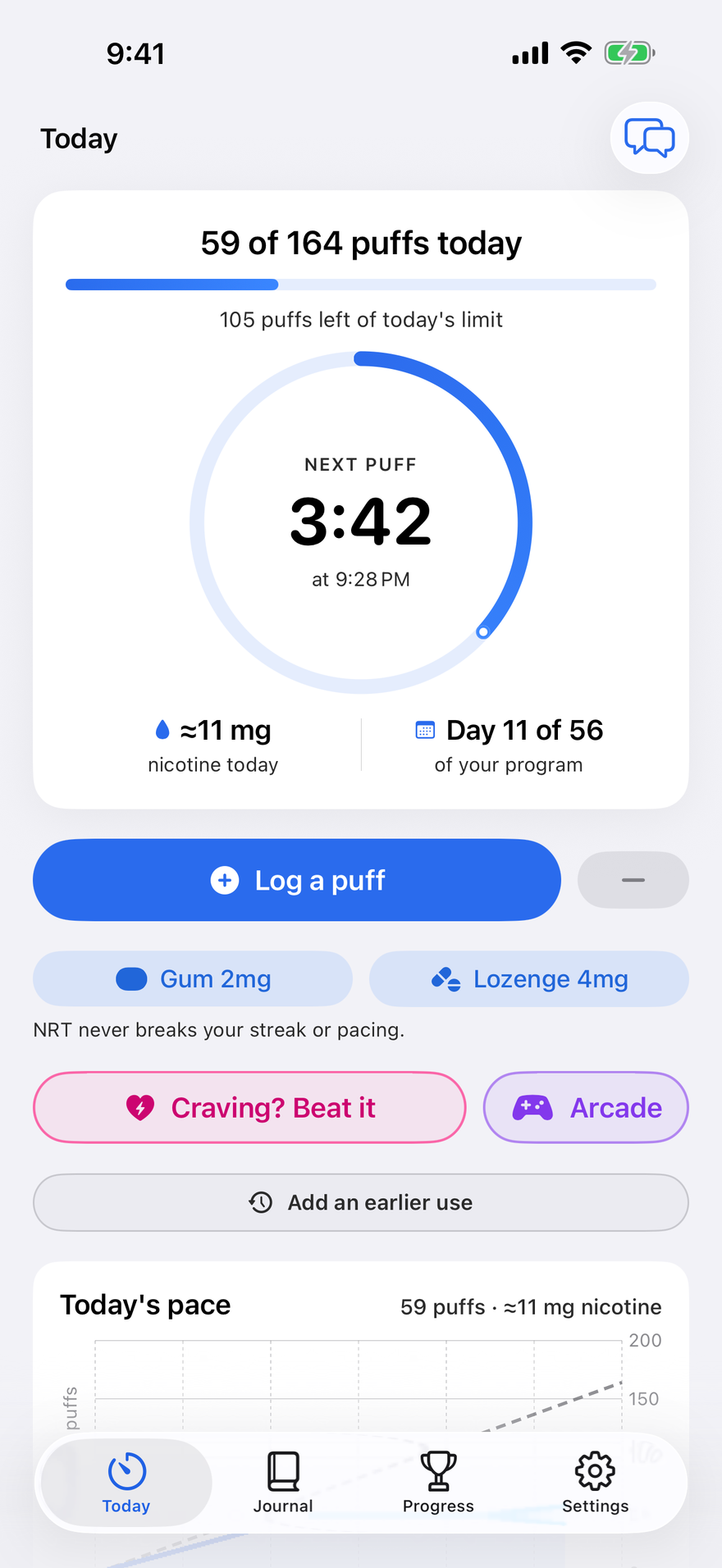
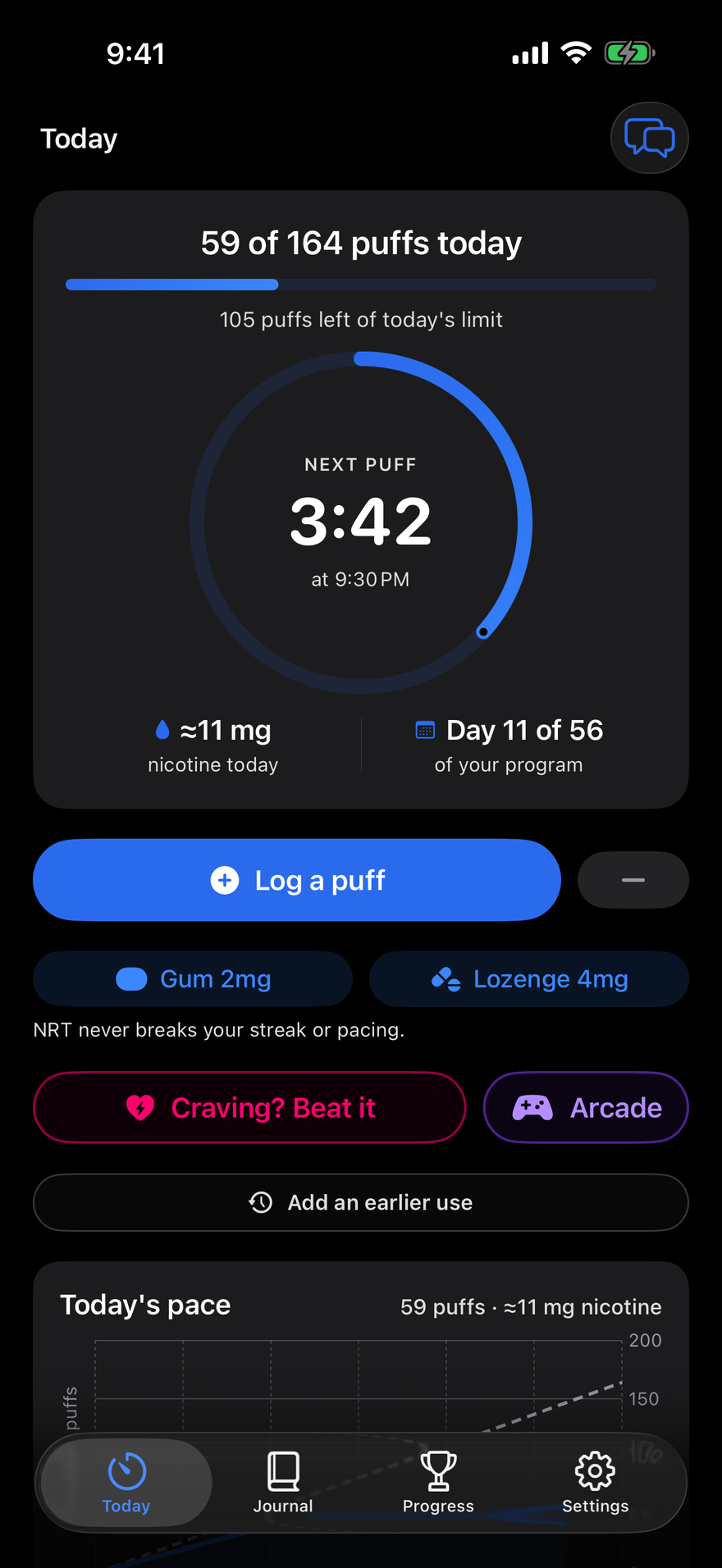
Puff Pacer's plan uses that kind of schedule. You choose a plan length from 2 weeks to a year, the plan lowers your daily count a little each day, and Puff Pacer's pacing countdown spaces your uses across your waking hours, so the gap between them stretches as you go. Your use steps down gradually instead of all at once.
How long does it take to break the habit itself?
A habit forms when you repeat the same action in the same situation. Habits form "by repeating the same responses in a given context," and once they do, they become "the efficient, default mode of response" (Annual Review of Psychology). That's why a cigarette with coffee, or a vape in the car, can happen before you've decided anything.
How long does the change take? In a University College London study, 96 volunteers chose a new eating, drinking or exercise habit and did it every day at the same point, such as after breakfast. The time for it to become automatic ranged from 18 to 254 days, "highlighting that it can take a very long time" (European Journal of Social Psychology). On average it leveled off after 66 days, so the researchers suggest expecting "around 10 weeks" (British Journal of General Practice).
Two findings from that research are worth keeping:
- A missed day doesn't undo it. "Missing the occasional opportunity to perform the behaviour did not seriously impair the habit formation process" (British Journal of General Practice).
- Habits outlast motivation. "Habits are likely to persist even after conscious motivation or interest dissipates" (British Journal of General Practice). That cuts both ways: the old nicotine habit persists, and so will the new routine you build in its place.
Those studies were about building new habits like eating, drinking and exercise, not quitting nicotine, so they tell you the pace of habit change in general. The practical lesson is the same: pick a new response for each old cue, and repeat it in the same place, at the same time.
How do you build habits that get you through cravings?
Give each trigger one planned response, and use it every time that trigger hits, so the new response gets the repetition the old one had.
That's what Puff Pacer's Craving SOS is for. It shows your own if-then plan, such as "When stress hits, walk first", built from your top trigger and the go-to that has most often gotten you through a craving. A ride-it-out timer, guided breathing, your replacements and the Arcade's four mini-games cover the minutes a craving lasts.
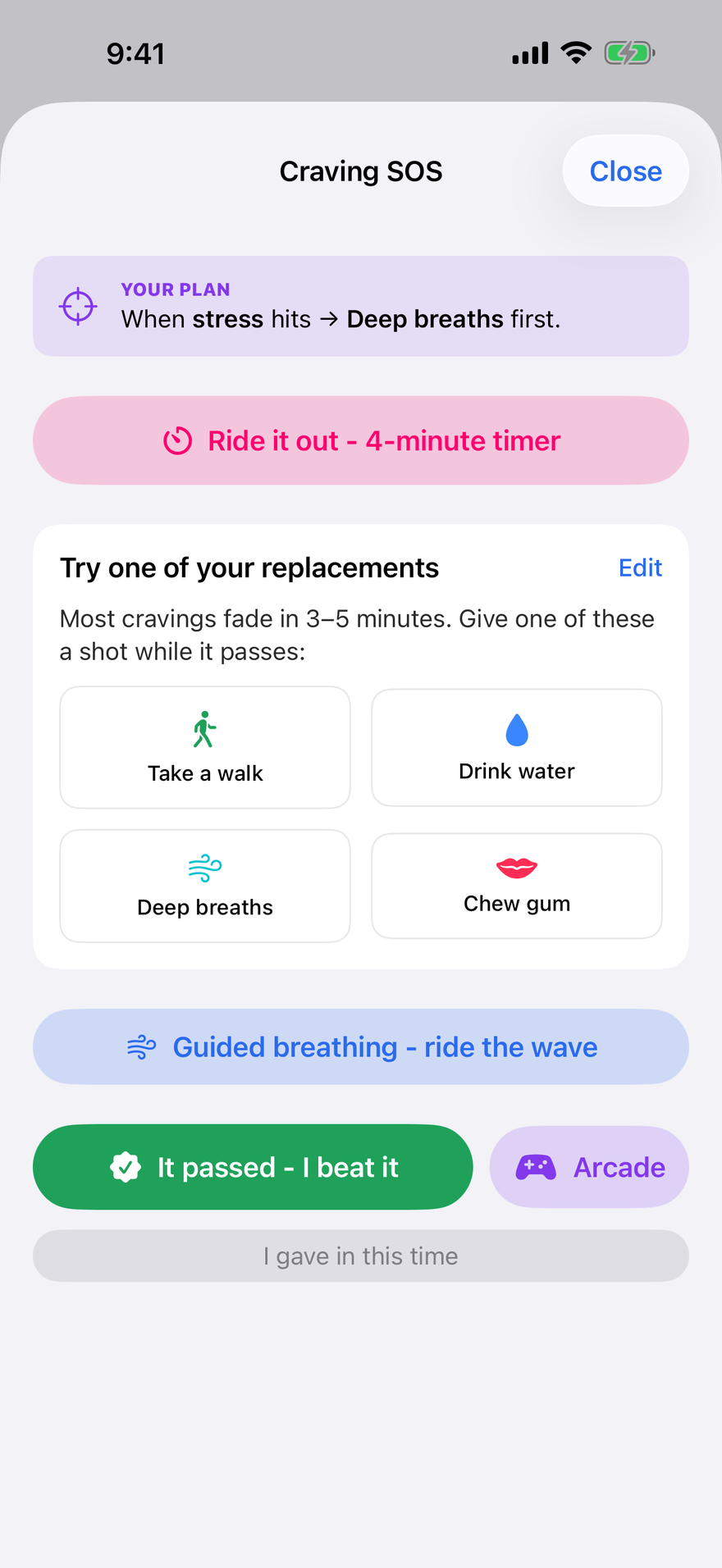
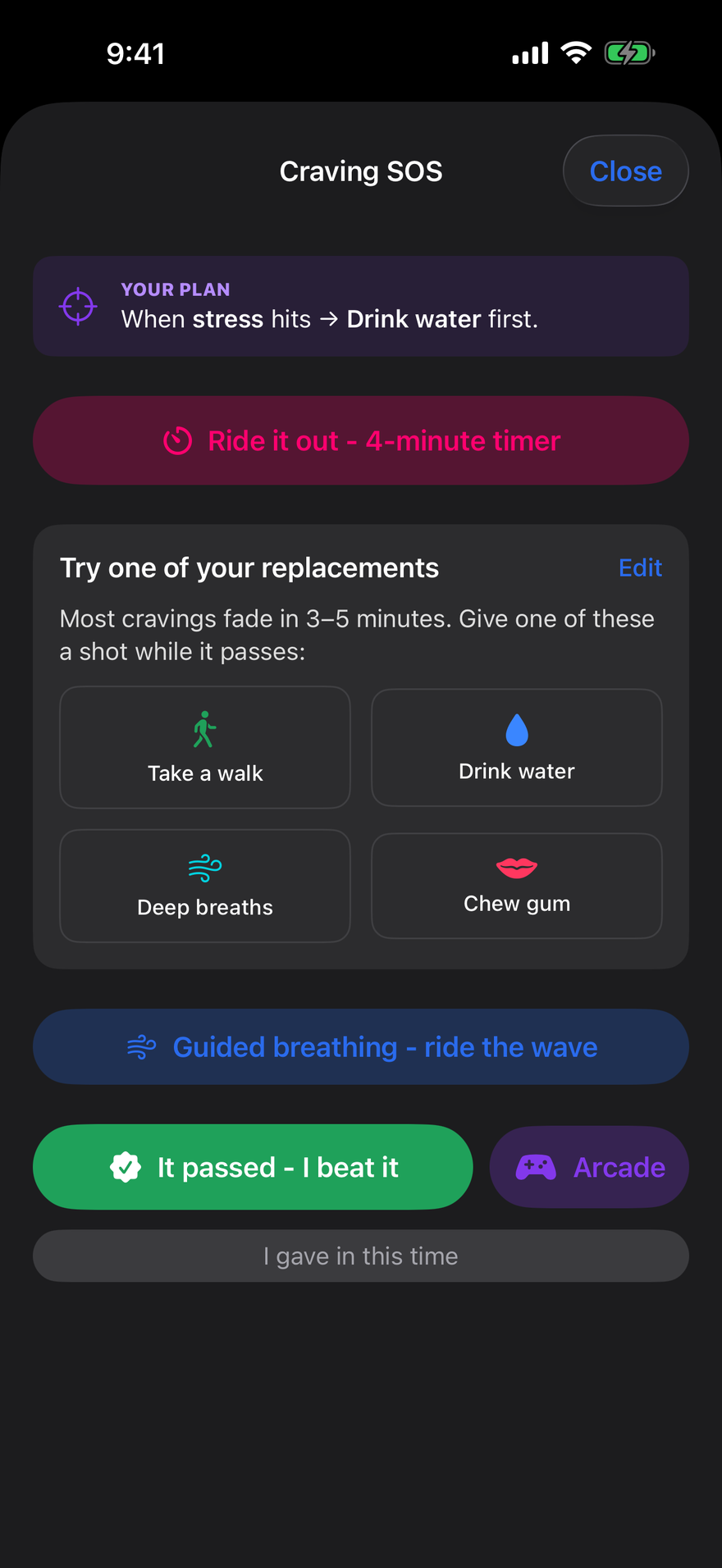
When you ride out a craving, you mark it beaten, and a 20-second daily check-in tracks your cravings and mood over time. A walk, a glass of water or a few slow breaths after the same cue, repeated for weeks, is the kind of routine the habit research says can become automatic and outlast motivation (British Journal of General Practice).
Why do cravings come back months later?
Cravings set off by cues can outlast withdrawal. Researchers call these cue-induced cravings: intense urges that come and go, set off by situations linked to smoking. They're "substantially responsible for relapse," but "smoking can often be averted by coping responses" (Ferguson and Shiffman, 2009).
They can even grow at first. In a study of 86 adults who smoked and were paid to stop, cravings set off by smoking cues were stronger after 35 days than after 7, "even as 'background' craving and withdrawal symptoms subside" (Biological Psychiatry).
That's why the first year matters most. In a large US survey, people who had stopped smoking for 12 months or less had a risk above 50% of going back. After a year the risk kept falling, but "it never fully disappears" (Drug and Alcohol Dependence).
What helps a change last?
Research points to a few things. None works for everyone, and most of the studies were of people who smoked.
- Plan your if-then responses. Linking a trigger to a planned response, such as "if I finish dinner, then I go for a walk," is called an implementation intention. Across 12 studies, an average of 10.7% of people who made these plans quit, compared with 4.9% of people who didn't, though results varied a lot between studies (Health Psychology).
- Reward staying quit. A Cochrane review of 48 studies found that rewards such as cash or vouchers for staying smokefree raised the chances of quitting at six months or longer, and "the effectiveness of incentives is sustained even when the last follow-up occurs after the withdrawal of incentives" (Cochrane).
- Keep support coming. Automated text-message programs helped more people quit than minimal support did (Cochrane), and more intensive counseling did somewhat better than brief counseling (Cochrane).
- Track what you do. In programs to change eating and exercise habits, self-monitoring was the technique most linked to results, especially when combined with other self-regulation techniques (Health Psychology).
Not everything has held up. For people who had quit with help, teaching coping skills for high-risk moments "provided no worthwhile benefit in preventing relapse" (Cochrane).
Apps like Puff Pacer give you tools for several of these techniques: they help you make a plan, record your use, and space it out on a set schedule while you build a new routine.
What if you slip?
Log it honestly and go back to your new routine the next day. In the habit research, an occasional missed day didn't undo a new habit (British Journal of General Practice), and the slip shows you which cue needs a better plan.
For the full plan, see how to quit smoking, how to quit vaping or how to quit Zyn and nicotine pouches.
Sources
- Smokefree.gov (National Cancer Institute), Managing Nicotine Withdrawal.
- Cosgrove KP, et al., Archives of General Psychiatry, beta2-Nicotinic acetylcholine receptor availability during acute and prolonged abstinence from tobacco smoking, 2009.
- Brody AL, et al., Neuropsychopharmacology, Treatment for tobacco dependence: effect on brain nicotinic acetylcholine receptor density, 2013.
- Cinciripini PM, et al., Journal of Consulting and Clinical Psychology, The effects of smoking schedules on cessation outcome: can we improve on common methods of gradual and abrupt nicotine withdrawal?, 1995.
- Cinciripini PM, et al., JMIR Formative Research, The Effects of Scheduled Smoking Reduction and Precessation Nicotine Replacement Therapy on Smoking Cessation: Randomized Controlled Trial With Compliance, 2023.
- Lindson N, et al., Cochrane Database of Systematic Reviews, Smoking reduction interventions for smoking cessation, 2019.
- Wood W, Rünger D, Annual Review of Psychology, Psychology of Habit, 2016.
- Gardner B, Lally P, Wardle J, British Journal of General Practice, Making health habitual: the psychology of 'habit-formation' and general practice, 2012.
- Lally P, et al., European Journal of Social Psychology, How are habits formed: Modelling habit formation in the real world, 2010.
- Ferguson SG, Shiffman S, Journal of Substance Abuse Treatment, The relevance and treatment of cue-induced cravings in tobacco dependence, 2009.
- Bedi G, et al., Biological Psychiatry, Incubation of cue-induced cigarette craving during abstinence in human smokers, 2011.
- García-Rodríguez O, et al., Drug and Alcohol Dependence, Probability and predictors of relapse to smoking: results of the NESARC, 2013.
- McWilliams L, et al., Health Psychology, Beyond "planning": a meta-analysis of implementation intentions to support smoking cessation, 2019.
- Notley C, et al., Cochrane Database of Systematic Reviews, Incentives for smoking cessation, 2025.
- Whittaker R, et al., Cochrane Database of Systematic Reviews, Mobile phone text messaging and app-based interventions for smoking cessation, 2019.
- Lancaster T, Stead LF, Cochrane Database of Systematic Reviews, Individual behavioural counselling for smoking cessation, 2017.
- Livingstone-Banks J, et al., Cochrane Database of Systematic Reviews, Relapse prevention interventions for smoking cessation, 2019.
- Michie S, et al., Health Psychology, Effective techniques in healthy eating and physical activity interventions: a meta-regression, 2009.
Frequently asked questions
How long does it take to break a nicotine habit?
Longer than withdrawal. Smokefree.gov says the worst withdrawal symptoms last a few days to a couple of weeks, and a brain-imaging study found nicotine receptors back to nonsmoker levels by 6 to 12 weeks. The habit can take months: in one study, a new daily habit took an average of 66 days to become automatic, and 18 to 254 days in all.
Does it take 21 days to break a habit?
Usually longer. In a University College London study of new daily habits, it took an average of 66 days for a habit to become automatic, and anywhere from 18 to 254 days. The researchers suggest expecting around 10 weeks. That study was about building new habits, not quitting nicotine, so take it as a rough guide.
Why do I still crave nicotine months after quitting?
Cravings set off by cues can outlast withdrawal. Researchers found these cue-induced cravings are a major reason people go back to smoking, but coping responses can often stop a slip. In one study of people who were paid to stop smoking, cravings set off by smoking cues were stronger after 35 days than after 7.
Does missing a day ruin a new habit?
No. In the University College London habit research, missing the occasional day did not seriously impair forming a new habit, and progress resumed after a missed day. If you slip while quitting nicotine, log it honestly, go back to your new routine and plan for the cue that caused it.
When is the risk of going back to nicotine highest?
In the first year. In a large US survey, people who had stopped smoking for 12 months or less had a risk above 50% of going back. After a year the risk kept falling but never fully disappeared, so keep your craving plan handy even after you feel settled.
Keep reading
Ready to quit at your pace?
Download Puff Pacer free and get a personalized taper plan for vaping, smoking, nicotine pouches, or chewing tobacco.


Disclaimers
Not medical advice. This article is for general information and education only. It is not medical advice and is not a substitute for advice, diagnosis or treatment from a doctor, pharmacist or other qualified healthcare professional. Talk to one before changing how you use nicotine or starting nicotine replacement products, especially if you are pregnant or breastfeeding, have a health condition or take medication. Reading this article does not create a doctor-patient relationship. In a medical emergency, call your local emergency number.
About the app. Puff Pacer is for building healthier habits and general wellbeing. It is not a medical device and is not intended to diagnose, treat or prevent any disease, including nicotine dependence. It is not medical advice: talk to a healthcare professional. Puff Pacer is for adults 18 and older.
Accuracy. We link our sources so you can check them. Health guidance changes over time, and this article reflects its sources as of its last update. It may not cover every situation.
Disclosure. The author, Todd Lahman, is the developer of Puff Pacer, the app mentioned in this article, and this site is published by Todd Lahman LLC. No one paid for this article, and it contains no affiliate links.
Trademarks and links. Zyn and other product names mentioned are trademarks of their respective owners, used only to describe their products. Puff Pacer is not affiliated with or endorsed by them. Links to other websites are for reference, and we don't control their content.
Use of this site is subject to our Terms of Use and Privacy Policy.